Updated: May 2026
How Much Does a Private Yacht Charter in Raja Ampat Cost?
- Vessel Class: A classic 4-cabin Phinisi will be at the lower end, while a 7+ cabin expedition super-yacht commands a premium.
- Seasonality: Peak season from December to February carries a 10-15% surcharge over shoulder season rates in October or April.
- Inclusions: Most charters are all-inclusive (crew, food, fuel, activities) but exclude special alcohol, park fees, and crew gratuity (10-15%).
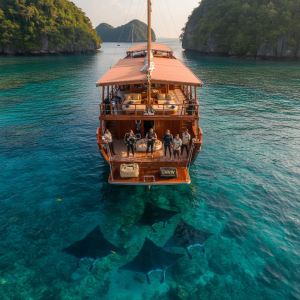
The air hangs heavy and warm, thick with the scent of clove and damp earth. From the bow of the Samata, the sea is a sheet of impossible turquoise, broken only by the dorsal fin of a blacktip reef shark cruising the shallows. A Blyth’s hornbill, a flash of prehistoric majesty, glides between the tangled canopy of a nearby karst island and disappears. This is the daily sensory immersion of a journey through Raja Ampat, an experience that feels less like a vacation and more like a privileged entry into one of the planet’s last true wildernesses. The question I hear most often in my role is not “is it worth it?” but rather, “what does an expedition of this caliber actually cost?” The answer, like the archipelago itself, is complex, layered, and deeply rewarding to explore.
Demystifying the Charter Rate: All-Inclusive vs. Plus-Expenses
When you begin to research the private yacht charter in Raja Ampat cost, you will encounter two primary pricing structures. Understanding them is the first step in planning a seamless expedition. The vast majority of vessels in this region, particularly the traditional Indonesian Phinisi yachts we specialize in, operate on an all-inclusive basis. This model offers transparency and simplicity. A single nightly rate, typically ranging from $4,000 to $12,000, covers the exclusive use of the yacht, the captain and full crew, all gourmet meals and non-alcoholic beverages, fuel for the main engines and tenders, and a host of activities like diving (often including a dedicated dive master and all equipment), snorkeling, kayaking, and paddleboarding. What is typically excluded? Discretionary crew gratuity, which is an industry standard of 10-15% of the base charter fee, marine park and port fees, and premium alcoholic beverages. This clarity allows for precise budgeting, a comfort my clients at Departures greatly appreciate.
The alternative, more common in the Mediterranean or Caribbean super-yacht scene, is the “plus-expenses” model, often governed by MYBA (The Worldwide Yachting Association) terms. Here, you pay a base charter fee for the yacht and crew, and then all other expenses are covered by an Advance Provisioning Allowance (APA). The APA is usually calculated as 30-35% of the base charter fee and is paid upfront. It covers fuel, food, drinks, port fees, and any other expenses incurred. The captain keeps a running tally, and you either receive a refund or pay the difference at the end of the charter. While this offers high customization, it can lead to unpredictable final costs, especially given the variable fuel consumption in an archipelago spanning over 40,000 square kilometers.
The Vessel Itself: Phinisi Craftsmanship vs. Modern Motoryachts
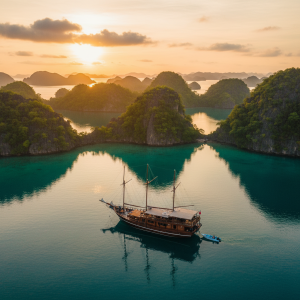
The soul of a Raja Ampat charter is undeniably the Phinisi. These are not merely boats; they are hand-built, two-masted wooden sailing ships, a testament to the boat-building artistry of the Konjo people of South Sulawesi. This tradition is so culturally significant it is recognized as a UNESCO Intangible Cultural Heritage of Humanity. A modern luxury Phinisi marries this ancient craftsmanship with every contemporary comfort. A 5-cabin vessel like the Rascal, sleeping 10 guests, might charter for around $8,000 per night. This includes air-conditioned en-suite cabins, expansive deck spaces, and a crew-to-guest ratio that often approaches 2:1. For larger groups or those seeking the pinnacle of expedition luxury, a super-Phinisi like the 65-meter Lamima offers seven palatial suites, an onboard spa, two PADI dive centers, and a crew of 20, with rates exceeding $15,000 per night.
The choice of vessel is the single largest determinant of your charter cost. While less common, modern motor yachts are available. They offer speed, which can be an advantage for covering vast distances, but they come with a different set of considerations. Their fuel consumption is substantially higher, which, under a “plus-expenses” model, can dramatically increase the final bill. A 40-meter motor yacht might have a similar base charter fee to a large Phinisi but could burn 500 liters of fuel per hour while cruising, compared to the Phinisi’s more modest consumption under motor or, ideally, none at all under sail. For many, the quiet grace and authentic connection to Indonesian maritime heritage offered by a Phinisi are integral to the Raja Ampat experience.
Seasonality and Itinerary: The Economics of Paradise
Like any exclusive destination, Raja Ampat’s charter rates are governed by the laws of supply and demand, which are tied directly to the seasons. The primary charter season runs from October through April, corresponding with the dry season and the calmest seas. Within this window, the absolute peak period is from mid-December to mid-February, encompassing the festive holidays and Chinese New Year. During these 8-10 weeks, expect to pay a premium of 10-15% on the standard rate, and it is not uncommon for the top-tier yachts to be fully booked 18 months in advance. One of my clients, a tech CEO from Palo Alto, has a standing booking for the first two weeks of every January.
The shoulder months—October, November, March, and April—are what I consider the sweet spot. The weather is superb, the marine life is just as prolific, and the anchorages are quieter. You may find more flexibility in yacht availability and occasionally a more favorable rate. From May to September, the southeast monsoon brings more wind and rain, particularly to the southern reaches of the archipelago. While some yachts relocate, others remain and offer significant discounts, sometimes as much as 25-30%. This can be an option for intrepid travelers, but it requires flexibility as itineraries may need to be altered based on weather. Itinerary length also plays a role. The standard charter is 7 to 12 nights. A 10-night journey is ideal, allowing enough time to explore from the iconic pinnacles of Wayag in the north down to the soft coral gardens of Misool in the south, a distance of over 150 nautical miles, without feeling rushed.
The Ancillary Costs: Park Fees, Gratuities, and Special Requests
Beyond the headline charter rate, a few additional costs must be factored into your budget for a complete financial picture. These are not hidden fees but standard components of any high-end charter. First is the Raja Ampat Marine Park permit, a mandatory fee that directly supports conservation and local communities. As mandated by the Indonesian government, the fee is IDR 1,000,000 per international visitor (approximately $65 USD at current exchange rates) and is valid for 12 months. Your charter broker will typically arrange these permits for your entire party in advance.
Next is the crew gratuity. The crew on these yachts are exceptional—a blend of seasoned sailors, expert dive masters, hotel-trained stewards, and creative chefs who work tirelessly for 12-16 hours a day to deliver a flawless experience. The industry standard for acknowledging this service is a gratuity of 10-15% of the base charter fee, given to the captain at the charter’s conclusion for distribution amongst the entire crew. For a 10-night, $80,000 charter, this would amount to $8,000-$12,000. While discretionary, it is a deeply appreciated custom. Finally, consider personalization. The beauty of a Raja Ampat luxury charter is that it is entirely bespoke. If you desire a specific vintage of Burgundy, a case of Japanese whisky, or daily lessons with a certified yoga instructor, these can all be arranged. These special provisions are billed at cost and will be itemized on your final invoice.
A Sample Cost Breakdown: A 10-Night Expedition for 10 Guests
To make this tangible, let’s construct a realistic scenario for a private charter. Imagine a multi-generational family of 10 planning a 10-night expedition in March. They select a renowned 5-cabin luxury Phinisi, a vessel known for its exceptional dive program and culinary excellence.
Here is a plausible breakdown of the private yacht charter in Raja Ampat cost:
- Vessel: A 45-meter, 5-cabin luxury Phinisi
- Rate: $8,500 per night (all-inclusive)
- Base Charter Fee (10 nights): $85,000
- Raja Ampat Marine Park Fees (10 guests x ~$65): $650
- Special Alcohol & Provisioning (curated wine list): $3,000
- Crew Gratuity (calculated at a conservative 12%): $10,200
- Total Estimated Expedition Cost: $98,850
This calculates to $9,885 per person for the entire 10-night journey, or $988 per person, per night. When you compare this to a stay at a top-tier overwater bungalow resort—which lacks the privacy, mobility, and exclusive access of a private yacht—the immense value becomes clear. There is no waiting for a transfer boat, no sharing a dive site with another group, and no set meal times. The yacht and its 16-person crew are yours. The entire 1,500-island archipelago is your private playground. It is the ultimate platform for experiencing a region that, according to Indonesia’s official tourism board, hosts 75% of the world’s known coral species.
Quick FAQ on Raja Ampat Yacht Charter Costs
Is it more expensive to charter in Raja Ampat than the Caribbean?
The nightly rates for comparable-sized yachts are often similar, but the operational logistics in Raja Ampat are more complex. The remoteness that makes the region so pristine also means fuel, gourmet provisions, and spare parts must be transported over vast distances, a cost factored into the charter rate. A 7-night charter on a 10-guest catamaran in the BVI might run $40,000-$60,000, while a Phinisi for the same group in Raja Ampat would be in the $50,000-$70,000 range, reflecting the expeditionary nature of the trip.
Can I find last-minute deals?
It is highly unlikely for reputable vessels during peak season. The best Phinisis are often booked a year or more in advance. Your best chance for a potential discount (perhaps 15-20%) is to be highly flexible with your dates and target the shoulder seasons (e.g., late April, early October), where a yacht might have an unexpected 8-night gap between two longer charters. Proactive booking is always the more prudent strategy.
What is the most cost-effective way to experience a charter?
The per-person cost drops significantly when you travel with a full group. A yacht that charters for $60,000 per week is $10,000 per person with 6 guests, but only $6,000 per person with 10 guests. Assembling a group of friends or family to fill the yacht is the single best way to maximize the value of your investment. It transforms a significant expense into a surprisingly reasonable price for an all-inclusive, rare private adventure.
Ultimately, a charter in Raja Ampat is an investment in an experience that transcends simple tourism. It is a deep dive into the heart of the Coral Triangle, a journey back in time aboard a vessel of living history, and a rare chance to disconnect from the world in order to reconnect with what truly matters. The numbers, while significant, are simply the gateway to an experience that is, for lack of a better word, priceless. Understanding the nuances of a Raja Ampat luxury charter is the critical first step. The next is to begin the conversation with an expert who has sailed these waters and can translate your vision into a perfectly executed expedition. Your private vessel awaits.